+90 548 839 98 19
+90 548 840 98 19
İskele, KKTC
Pzt-Cum: 09:00-17:00 | Cts: 09:00-14:00

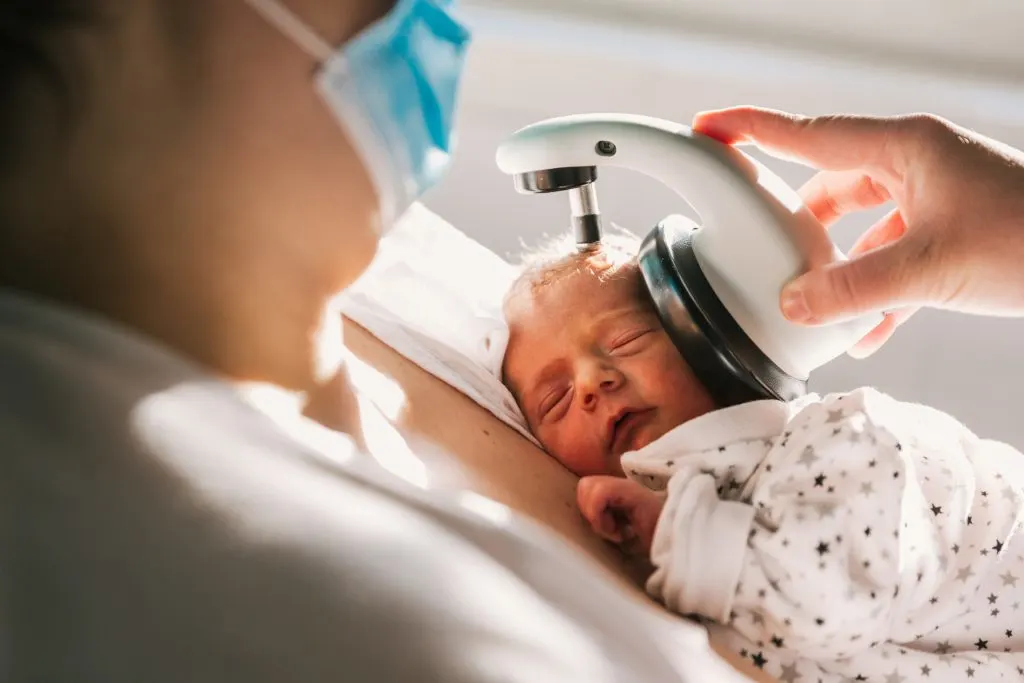
3 out of every 1000 babies are born with hearing loss. In 2020, 97.2% of babies born in the United States had their hearing screened before 1 month of age, and 6,291 infants were diagnosed with permanent hearing loss.
Newborn hearing screening is performed in order to detect children born with hearing loss or who experience hearing loss in the postnatal period at an early stage and to carry out appropriate treatment and rehabilitation practices. It is important that babies with hearing problems detected in newborn hearing screening are sent to reference centers for examination, monitoring of the results and early rehabilitation.
Passing the screening does not necessarily mean that the child's hearing is normal. Minimal and frequency-specific hearing losses are not targeted in newborn hearing screening programs. Current screening technology is effective at detecting hearing thresholds of 35-40 dB HL and higher. Therefore, newborns with mild hearing loss can undergo hearing screening. For the screening to be considered "passed", both ears must pass the screening in one session. If one ear does not pass, both ears need to be rescreened. If the newborn passes the screening or rescreening, screening is completed if there are no risk factors for late-onset or progressive hearing loss. Since mild hearing loss has the potential to affect children's speech, language and psychoeducational development, it is very important to monitor hearing, speech and language milestones throughout the child's developmental stages.
Consanguinity between parents
Family history of hearing loss
Use of ototoxic drugs during pregnancy
Premature birth
Toxoplasma
Rubella (German Measles)
CMV (Cytomegalovirus)
Herpes Simplex
Syphilis
Hyperbilirubinemia (Jaundice)
Bacterial Meningitis
Birth weight below 1500 g
Having received respiratory support for more than 5 days after delivery (Mechanical Ventilation)
Low Apgar score
Presence of signs and symptoms of syndromes known to be associated with hearing loss
Ear and head anomalies
The screening is done in the nursery or in a quiet room while the baby is resting or sleeping. If the baby cannot sleep, the test can be continued quietly on the mother's lap.
Hearing screening should be done after birth, before hospital discharge or within 3 days of birth. Criteria recommended by early hearing loss diagnosis and intervention programs include completion of hearing screening no later than 1 month of age, audiological diagnosis of any hearing loss by 3 months of age, and selection and fitting of hearing aids/cochlear implants within 1 month of parental confirmation of hearing loss.
The importance of early diagnosis and treatment of hearing impairment in newborns has been extensively researched. Significant developmental delays have been identified due to delayed diagnosis and treatment of hearing loss in infants.
Untreated permanent hearing loss, especially when congenital or acquired early in life, significantly impedes a child's development. Permanent hearing loss in childhood has a negative impact on language, cognitive, psychosocial, educational and occupational development. Newborn hearing screening has been shown to significantly reduce the age of diagnosis and intervention for permanent hearing loss in children. Hearing-impaired children who are identified early and receive appropriate rehabilitation with hearing aids or cochlear implants have been found to perform better in general language development, vocabulary and quality of life than children without hearing screening. In Cyprus, newborn hearing screening is performed at our Iskele Hearing Center. Take a look at our AABR test used for newborn hearing screening at our center.